
Thoroughly and Methodically
A story about panic, process, and a child’s best chance

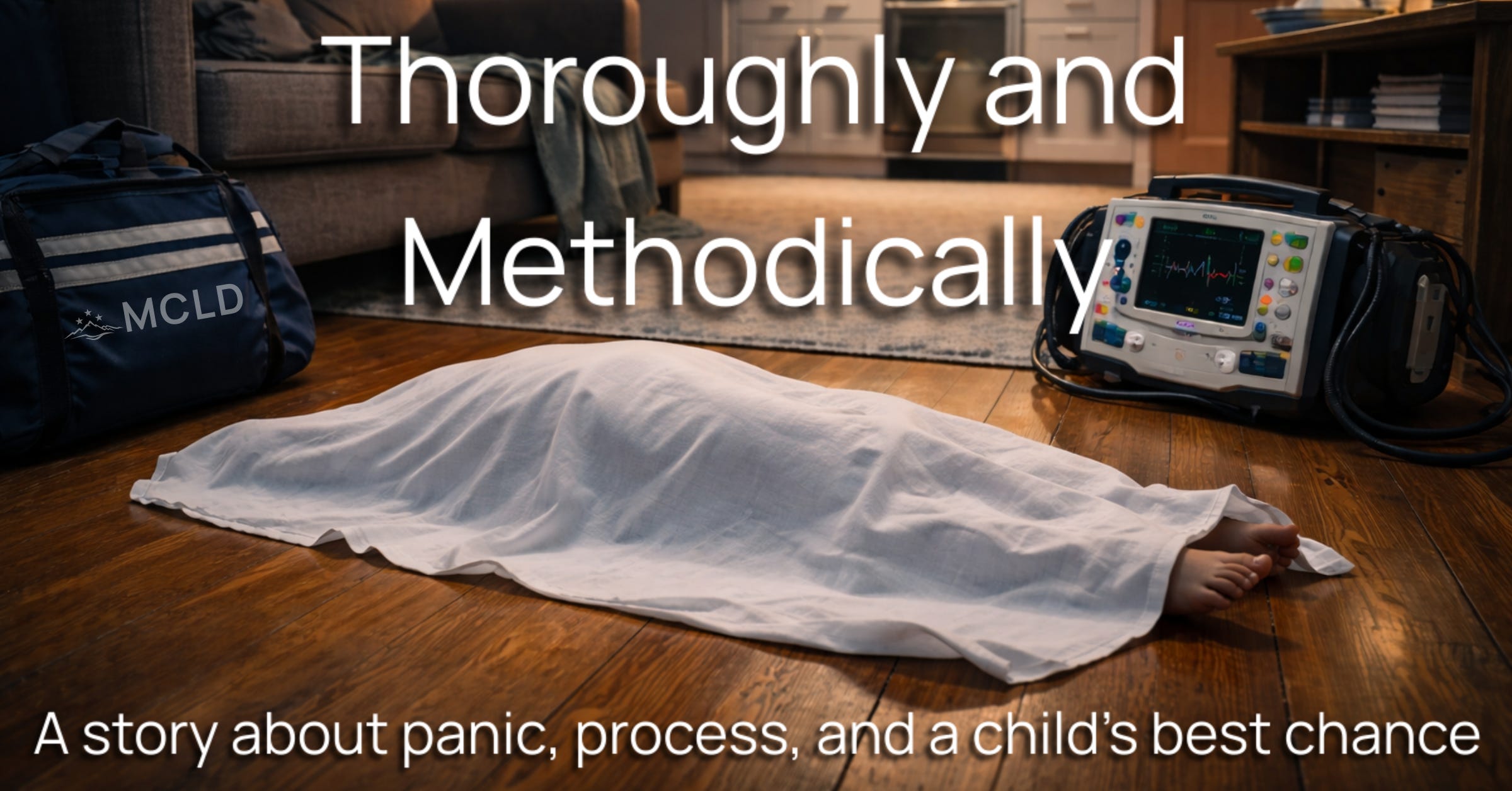
By the time we had them on the living room floor, the room was already full.
Not crowded in the way people think of crowded. Small apartment. Third floor walk-up. Sometime after midnight. Hardwood floors. A couch pushed too close to the wall. A lamp still on. The kind of room built for ordinary nights, not this one.
The child was eleven.
My paramedic partner was at the head of the patient getting ready to secure the airway by way of endotracheal intubation. The two EMTs from the BLS crew were moving with us, opening equipment, handing over what was needed, doing the work that keeps a resuscitation moving. I was coordinating and taking charge of the scene. Trying to keep the room narrow in my mind even if it felt wide to everyone else.
Mom stood off to one side with tears in her eyes, looking like her body had not yet caught up to what was happening in front of her. Dad was flushed, agitated, bouncing between panic and anger the way people do when the worst thing they can imagine is happening in their own home and right in front of them. He wanted action he could recognize. Movement. Urgency. A stretcher in motion. An ambulance pulling away fast enough to make him believe something was changing.
What he was seeing instead was us on the floor.
He looked at all of us working around his son and said what many people in that moment would say.
“Get him to the hospital. Why are you wasting time?”
I understood why he asked it.
To most people, the hospital is where care happens. The ambulance is what gets you there. The scene is the delay before the real treatment starts. They do not see what we see. They do not know what can be done in the field and what has to be done right here, right now, before the ambulance ever starts rolling.
That misunderstanding is not stupidity. It is distance. Most people never have to know what paramedics are capable of in the worst minutes of a life. They think of transport first. They think of sirens first. They think speed means help.
Sometimes speed matters.
But on calls like this, sequence matters more.
These are low-frequency, high-risk calls. Pediatric arrests. Status epilepticus. Children who go from sick to critical so fast that the room itself seems to tilt. Calls that test everybody. The family. The crew. The training. The ability to stay inside the next right thing instead of getting swallowed by the whole picture.
That is where panic waits for you.
Not always in the loudest form. Sometimes it comes dressed as urgency. Hurry up. Move faster. Get out of here. Do something. It reaches for the crew from the outside, and if you let it, it starts growing on the inside too.
That is why your approach has to already be there before the call ever comes in.
Thoroughly and methodically.
Not because the call is calm. It is not.
Not because the family is calm. They should not be.
Not because you feel calm. You might not.
You do it thoroughly and methodically because that is what grounds you when the room is fighting hard against order.
My partner stayed focused at the head, managing the airway, ventilating, keeping attention on what mattered there. The EMTs moved in step, one helping us with the resuscitation, one helping create a little bit of space around the family while still keeping eyes and ears on the room. We assessed what needed to be assessed. We treated what needed to be treated. We relied on the basics because the basics are not small on a call like this. Basics are the frame the rest of the care hangs on.
Airway. Breathing. Circulation. Rhythm. Access. Medications. Reassessment.
No wasted movement. No frantic improvisation. No chasing panic.
Methodical does not mean slow.
It means deliberate.
It means you do not skip steps because the room is loud.
It means you do not let someone else’s fear rush you past the science.
It means you narrow possibilities by assessing thoroughly and treating intentionally instead of reacting to noise.
Mom’s voice kept cutting through in pieces.
“Why is this happening?”
“Why?”
There are questions families ask in moments like this that do not have answers anyone in the room can give them. Not then. Sometimes not ever. They are not really asking for an explanation in the medical sense. They are asking because their world has broken open and language is all they have left.
One of the EMTs turned toward her while my partner and I stayed with the child and said,
“You’re experiencing a completely normal reaction to a very abnormal event.”
It was the right thing to say.
Not polished. Not dramatic. Not false reassurance.
Just honest.
Families do not need us to outtalk the moment. They need us to steady it. They need to know that their fear is seen and that their reaction is not wrong. Compassion does not pull us away from the medicine. It is part of the medicine. The art of these calls sits right alongside the science. You cannot do one and neglect the other.
Dad was still keyed up, still wanting motion, still looking at the door as if that was where rescue lived.
“Get him to the hospital.”
“Why are you still here?”
I looked at him and gave him the truest answer I had.
“His best chance of survival is to do these things right here and now.”
That line did not come from a script. It came from experience. From understanding that in calls like this, the floor becomes the emergency room before the ambulance ever becomes transportation. We were not standing around. We were not wasting time. We were doing everything that had to be done where it had to be done first.
People outside the profession sometimes imagine prehospital care as a bridge between home and hospital. A ride. A handoff. A delay before the experts take over.
But this is part of the expert care.
This matters.
What we do in those first minutes matters. How we assess matters. How we ventilate matters. How we organize the room matters. How we communicate matters. Whether we let ourselves get dragged into panic matters. Whether we remember the family while we work matters.
Especially with children.
Especially when the room is telling you to move before the patient is ready to move.
I have had more than one call like this. Different homes. Different children. Different endings. Some were seizures. Some were arrests. Different symptoms. Different parents. Different neighborhoods. But the lesson keeps returning to the same place.
If your everyday approach is sloppy, panic will expose it.
If your everyday approach is thorough and methodical, stress will fall back onto training.
That is what gets you through.
Not bravado.
Not volume.
Not pretending you are untouched by what is happening.
You get through by trusting your process. You get through by relying on the basics. You get through by leading the room instead of letting the room lead you. You get through by remembering that low-frequency calls do not require a new version of you. They require the same disciplined version of you, now under more pressure.
And while all of that is happening, you never forget the family.
Never.
They may not remember every intervention. They may not understand every decision in the moment. But they will remember your tone. They will remember whether someone saw them. They will remember whether the room felt abandoned to chaos or held together by calm hands and clear voices.
That matters too.
So, when the call comes in and the stress hits fast, do not make the mistake of thinking you need to become frantic to match the moment.
You do not.
You need to become more disciplined.
More deliberate.
More grounded in what you already know.
Thoroughly and methodically.
Because in that apartment, on that floor, in the worst moment of that family’s life, their child’s best chance of survival is to do these things right here and now.
About the author
Mike Chanat is a paramedic, leader, and educator with nearly four decades of experience in emergency medical services, fire, and law enforcement. He writes about leadership, presence, and the human moments that shape those who serve

A month or two ago at an event I was running someone went into cardiac arrest. They cleared the huge ballroom, enough for a couple of thousand people, and the EMTs worked on the individual for close to an hour. I was one of the few people allowed to stay, and it was like looking through binoculars in reverse; huge empty ballroom with just a few humans in the middle trying desperately to save a life. It will stay with me.
On your broader point, one of my meditation teachers always used to say something along the lines of "you practice on the cushion to prepare for real life." That's so true - all of that practice is what kicks in automatically when life goes completely sideways. You can't be calm and methodical without endless practice, which you deftly point out.
Great article, Mike.
Mike, this is powerful.
What stood out to me most is the reminder that calm is not the absence of urgency. Calm is discipline under pressure.
Your article makes it clear that the best professionals do not rise to the level of panic in the room.
They fall back on training, process, basics, and purpose.
That lesson applies far beyond emergency medicine.
“Thoroughly and methodically” is not slow.
It is leadership.
It is the ability to do the next right thing when everyone around you is begging for motion, noise, and visible activity.
Sometimes the most important action is not the fastest one.
It is the correct one, done in the correct sequence, by people trained well enough to trust the process.
This was a strong reminder that preparation matters, communication matters, and compassion belongs in the room right next to competence.
Excellent piece.