
Goodbye.
One Final Moment of Care

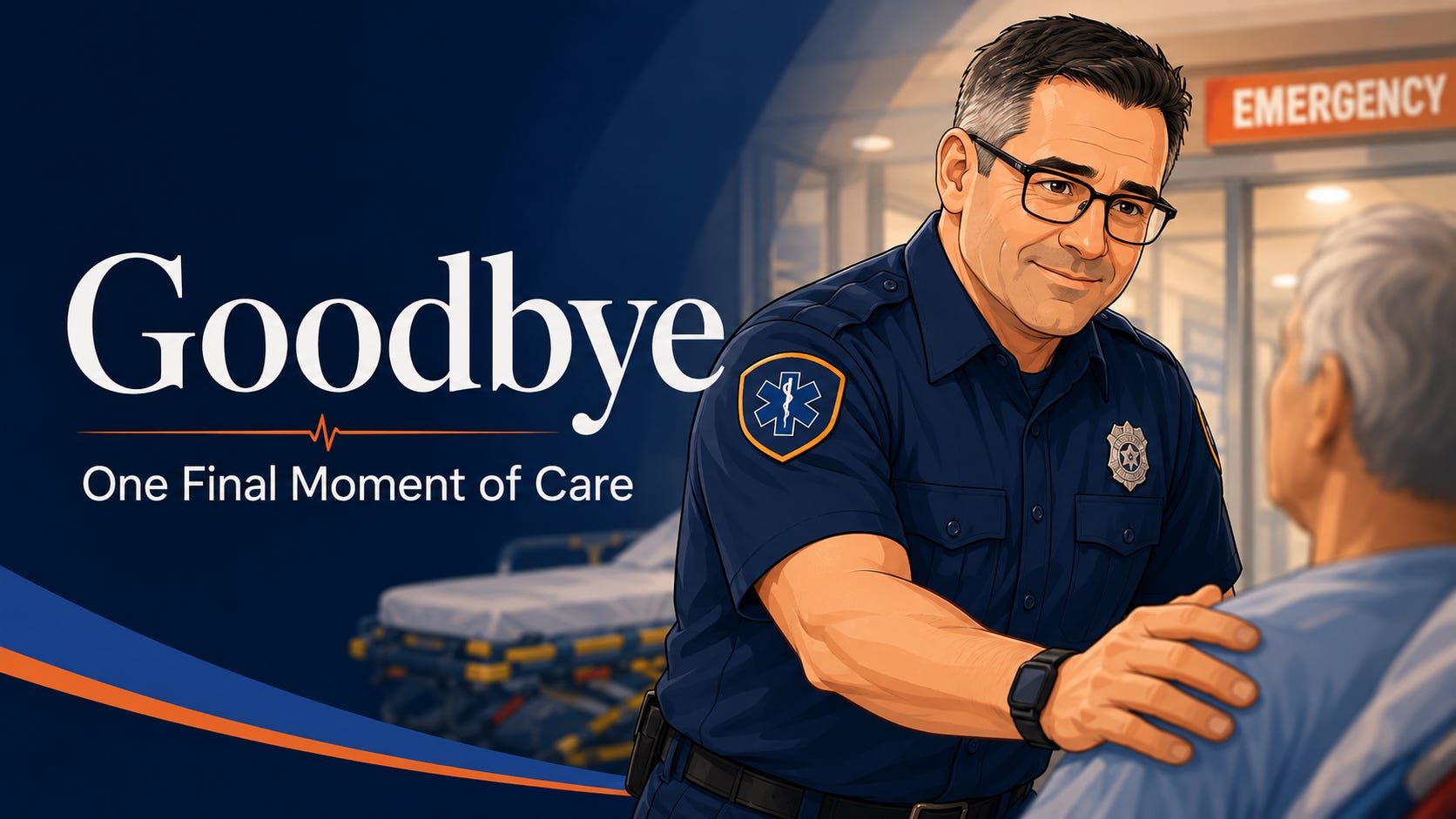
I was listening recently to Mark Norris and his co-hosts on the EMS leadership podcast DAMN Good Medics. They were talking through a series of “Hot Mic” topics when one of the co-hosts shared something one of his mentors had taught him.
The mentor asked if he had said goodbye to the patient.
He had not.
The mentor corrected him.
Since then, saying goodbye became part of his practice.
As I listened, I realized something.
I do the same thing.
I do not remember when I started. I do not remember anyone in EMS teaching it to me. It was not part of my EMT class. It was not in paramedic school. No preceptor pulled me aside and told me to do it. No supervisor explained it as a best practice.
It was simply something I did.
At the end of the call, after the report, after the transfer of care, after the monitor came off and the stretcher was cleaned, I said goodbye.
Sometimes it was, “Good luck.”
Sometimes it was, “I hope you feel better.”
Sometimes it was, “Take care of yourself.”
Sometimes it was a hand on the rail, eye contact, and a simple, “Goodbye.”
It sounds small.
It is not small.
I blame my parents for it.
I blame them for a lot of things.
Being kind. Respecting people. Holding doors. Saying thank you. Living a life of service. Treating people with dignity even when nobody else is watching.
Over the years, when someone has complimented me on something like that, my usual joking response has been, “Blame my parents.”
There is truth in the joke.
Some habits come from policy. Some come from training. Some come from culture. Some come from the people who raised us before we ever touched a stretcher, wore a uniform, or answered a call.
Saying goodbye is one of those habits for me.
I have seen what it does.
A patient who looked tired suddenly smiles.
A family member standing near the bed softens for a second.
Someone who spent the last 30 to 60 minutes scared, embarrassed, angry, confused, or in pain gets one final reminder.
They were seen.
They were not only transported.
They were not only assessed.
They were not only treated.
They were cared for.
There is a difference.
I have felt the same thing when I return to an emergency department a few hours later with another patient and see someone from an earlier call still there. I check in. I ask how they are doing. I smile. They smile back.
For a moment, the relationship has an ending.
Not a dramatic one.
A human one.
EMS relationships form fast. We walk into someone’s life during a bad moment, ask personal questions, touch their body, enter their home, speak with their family, make decisions, and move them from one place to another.
Then, as quickly as we arrived, we leave.
The call ends.
The chart begins.
The radio goes off again.
The system moves on.
But the patient does not always move on as quickly.
Neither should we.
A goodbye gives shape to the encounter. It closes the loop. It reminds you the person on the stretcher was never a task, a run number, a disposition, or a bed assignment.
They were a person.
I have heard people say EMS is “just a job.”
I have heard patients described as “just a call.”
Once, I even heard someone refer to a patient as a piece of meat.
I have never forgotten it.
I also never accepted it.
If this work becomes only that, something has gone wrong.
This line of service should bring some measure of joy. It should bring fulfillment. It should bring satisfaction. Yes, it brings stress. It brings fatigue. It brings hard calls, bad days, and moments we carry longer than we expected.
But at its core, this work is still people helping people in a time of need.
That has to matter.
Saying goodbye helps me remember.
It reminds me to slow down before I leave the room.
It reminds me to look at the person, not the paperwork.
It reminds me to end the call with the same respect I tried to bring at the start.
You do not need a title to do this.
You do not need permission.
You do not need a policy.
Before you walk away, say goodbye.
Mean it.
Then carry that habit into the next call.
About the author
Mike Chanat is a paramedic, leader, and educator with nearly four decades of experience in emergency medical services, fire service, and law enforcement. He writes about the calls, people, and moments that shaped his life in service, and the lessons that continue to follow him.
WOW!!!!!! Powerful story, Mike. And, made me stop and realize, I always had a parting word for patients as well. Thanks for the reminder.
Mike, this is a powerful reminder that the smallest acts often reveal the most about who we are.
Saying goodbye may not be written into a policy or taught in a classroom, but it communicates dignity, compassion, and respect. It tells the patient they were more than a call, a chart, or the next task on the schedule.
Your article also highlights something important about leadership.
Culture is built through the habits people choose when nobody is requiring them to do it.
Well said, my friend.
Never underestimate the impact of ending an encounter with kindness.