
The Paper Before the Framework
What a 2010 capstone revealed about credibility, leadership, and finding my voice.

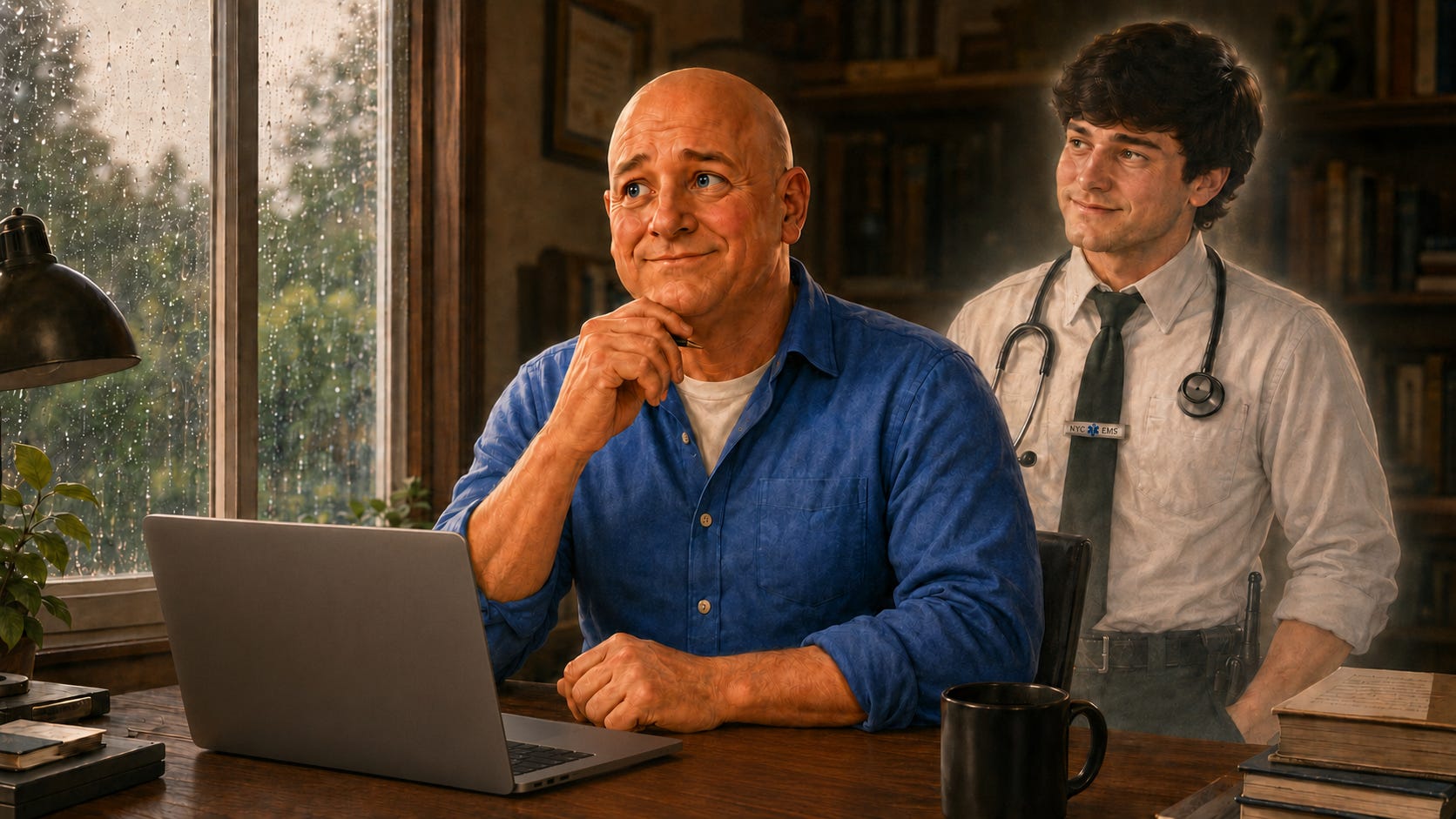
On an uneventful Friday afternoon, I opened an academic paper I had written in March 2010 and found an earlier version of myself trying to prove he belonged.
I won’t call the afternoon quiet.
People in EMS know better.
A gentle rain tapped against the windows. Cars moved along the wet pavement outside. I sat at my desk at work, scrolling through my LinkedIn profile, when I stopped at the education section.
Capella University.
Master of Science.
I’m not sure why I paused there.
Perhaps it was curiosity. Perhaps it was nostalgia. Perhaps something in me wanted to look back at a part of my life I hadn’t visited in years.
So I did.
I found my graduate school capstone proposal, downloaded the PDF, and opened it.
The title page appeared first.
The Case for Distance Education in Emergency Medical Services.
Michael J. Chanat.
March 2010.
The page felt formal and distant from how I write today.
The title was precise. The formatting was proper. The language was careful.
It looked like the work of someone who wanted to be taken seriously.
In many ways, it was.
I had returned to school as an adult. I finished my undergraduate degree only two years earlier, after walking away from college when I was younger because I didn’t understand its value at the time.
Nearly two decades passed before I returned.
Life filled those years.
EMS.
Police work.
Fire service.
Paramedic work.
Teaching.
Responsibility.
Family.
Bills.
Long shifts.
Then I went back.
I didn’t return because the timing was perfect. I returned because part of me still wanted to finish what I had started.
The master’s degree was partly about credibility.
I wanted to open doors as an adjunct professor. I wanted to enter academic spaces where field experience alone wasn’t always treated as enough. I wanted others to recognize the value of what I had learned over years of caring for patients, teaching students, and working beside other emergency responders.
I also wanted to prove something to myself.
Perhaps especially to myself.
I don’t know if I would have called it imposter syndrome then. I’m not sure I had the language for it.
I knew there were rooms where I felt pressure to prove I had earned my seat.
Reading the capstone again, I saw how hard I had worked to do exactly that.
Every citation was carefully placed.
Every statement had support.
Every section followed the expected structure.
The paper didn’t sound like the stories I write today. It didn’t sound like a conversation after a call or a reflection shared over coffee. It didn’t sound like someone who had learned to trust his own voice.
It sounded like a man learning how to translate years of field experience into language an academic audience would accept.
It didn’t sound like me today.
It was still mine.
I don’t criticize the man who wrote it.
He was doing the work.
He was reading the research, building an argument, and connecting what he knew from the field with what he was learning in graduate school.
He was learning a new way to communicate.
The degree didn’t create his credibility. It gave him another way to demonstrate it.
That distinction matters to me now.
A degree adds knowledge, structure, and perspective. A title creates responsibility. A promotion gives someone authority within an organization.
None of those things marks the exact moment when growth begins.
The work often starts earlier.
The subject of the paper still mattered.
Distance education in emergency medical services.
In 2010, I was asking whether EMS education needed to move beyond the traditional classroom.
Would online or hybrid learning better serve providers who worked long shifts, raised families, missed sleep, and still needed to maintain certifications in a profession where the learning never stops?
At the time, distance education remained outside the norm for much of EMS.
Ten years later, the COVID-19 pandemic forced much of that conversation into reality.
Classes moved online.
Meetings moved online.
Continuing education moved online.
What once seemed like an alternative became the primary option almost overnight.
The pandemic proved the importance of access. It also exposed the difference between placing material online and designing education around how people learn.
Distance education became normal.
Good distance education remained a work in progress.
We still need to ask what helps providers grow and what merely checks a box.
Does the format fit the learner?
Does the material connect with the work?
Does the education respect the realities of shifts, fatigue, family responsibilities, and limited staffing?
Are we building education around the people learning, or are we expecting people to fit a system designed without them in mind?
Those questions felt familiar because the paper wasn’t only about technology or course delivery.
It was about people.
Providers trying to maintain their certifications around unpredictable schedules.
Managers trying to cover ambulances while sending people to class.
Communities still depending on those ambulances.
Students trying to grow without being worn down by the process.
Underneath the academic language, I saw the same concern I still carry today.
I also saw an earlier version of myself.
He didn’t yet write about leadership, presence, and the human moments shaping those who serve.
He didn’t have The Key 3™.
He didn’t call his ideas a framework.
He had instincts before he had language.
He was already frustrated by systems making growth harder than it needed to be.
He cared about the provider sitting through class after a long tour.
He cared about the agency struggling to keep units staffed.
He cared about the student who wanted to advance but needed a path fitting real life.
Those concerns were already present.
Then I reached the final pages.
One sentence stopped me.
I had written that distance education should be considered in contingency planning because “a good leader thinks of his people and their needs.”
A good leader.
I sat with those words.
Today, I would phrase the sentence differently.
A good leader considers their people and what they need.
The wording has changed.
The belief hasn’t.
In 2010, I wasn’t comfortable writing and speaking about leadership the way I do now.
I had led in many ways.
I had taught.
I had mentored.
I had accepted responsibility.
I had worked in positions where others looked to me for guidance.
Still, claiming the word leader felt different.
The word carried weight.
Perhaps I believed leadership belonged to someone with a higher title. Perhaps I thought I needed more proof. Perhaps I was waiting for someone else to tell me I had earned the right to use it.
Yet there it was in my own paper.
A good leader thinks of his people and their needs.
I read the sentence as the man I am today, but I felt the person I was when I wrote it.
The adult student.
The adjunct professor trying to establish credibility.
The paramedic with years behind him and plenty still ahead.
The man returning to finish something he had walked away from years earlier.
The educator trying to improve a system affecting people he cared about.
I would never force The Key 3™ onto a paper written years before I developed the framework.
Still, I recognize its roots.
How do we communicate learning in a way people understand and access?
Are we willing to rethink systems built around tradition rather than real life?
Do we consider the experiences and needs of the people affected by our decisions?
Communication.
Mindset.
Empathy.
The framework didn’t exist yet.
The concerns behind it did.
The same pattern appears throughout EMS.
A provider starts mentoring new partners before receiving the title of preceptor.
A crew member begins leading during difficult calls before earning a stripe, badge, or bar.
An instructor shapes the future of the profession before feeling comfortable calling themselves an educator.
A supervisor starts caring for the growth of others long before learning how to describe their leadership philosophy.
The role often begins before the recognition.
The values often appear before the title.
The work often starts before we feel ready to claim it.
That realization stayed with me.
Growth doesn’t always feel like growth while we are living through it.
Sometimes it feels like doubt.
Sometimes it looks like rewriting a sentence several times because we fear someone will question whether we belong.
Sometimes it means returning to school while balancing work, family, and adult responsibilities.
Sometimes it means entering a new role with years of experience and still feeling like the least qualified person in the room.
Sometimes it means learning to support an idea with research before trusting our experience enough to speak in our own voice.
One honest sentence waited inside an old paper for sixteen years before showing me where part of my work began.
I opened the PDF expecting an old assignment.
Instead, I found an earlier version of myself.
He was still unsure in some ways.
He was still trying to prove himself.
He was still learning how to express what he believed.
I don’t look back at him with embarrassment.
I look back with respect.
He returned to school while carrying the responsibilities of work, family, and adult life.
He studied.
He wrote.
He questioned.
He kept moving forward.
He was closer to the work he would later claim as his own than he understood.
The degree didn’t make me a leader.
The paper didn’t create the framework.
Both helped me put language around work already underway.
The framework came later.
The confidence came later.
My voice came later.
The concern for people was already there.
Perhaps part of your work has already started too.
Look back at something you wrote, taught, questioned, or cared deeply about earlier in your career.
What part of the leader, educator, mentor, or provider you are becoming was already present?
You might be further along than you think.
Author Bio
Mike Chanat, MS, NRP, is a paramedic, educator, speaker, and founder of Mike Chanat Leadership Development. Drawing on nearly four decades across EMS, fire service, law enforcement, and education, he helps EMS professionals and leaders grow through The Key 3™ framework of Communication, Mindset, and Empathy. He writes about leadership, presence, and the human moments shaping those who serve.
Mike, you looked back and saw yourself fulfilling the requirements required to obtain the key necessary to unlock the you that you have become today. The key to open the door that allows you to step thru and deliver what you know you can deliver and what is needed to be delivered.
We all have to fit into molds, sometimes. But, we should never lose sight of who we truly are.